Best Courses
Shinnecock Hills & National Golf Links Guide
Southampton's two private neighbors: their history, their championships and how the public sees them
Updated · November 20, 2026
Shinnecock Hills Golf Club and National Golf Links of America share the same sandy ground in Southampton, close enough that from Shinnecock's 3rd tee, Golf Club Atlas notes, National is about 55 yards away. They are No. 1 and No. 2 in Golf Digest's 2025-26 ranking of New York's best courses, and both are private clubs for members and their guests. This guide is for golfers who want to know why they sit at the top of that list, how they came to be neighbors, and the one way the public gets inside the gates: as spectators when the USGA brings a championship.
Shinnecock Hills: the club and its course
The club dates to 1891, describes itself as the oldest incorporated golf club and was among the USGA's five founding clubs. Its 1892 clubhouse, by McKim, Mead and White, still sits above the course. The first 12 holes were Willie Davis's; 18 followed in 1895, and four revisions came before the course played today.
One of those revisions came from next door. After building National, C.B. Macdonald and Seth Raynor reworked Shinnecock, and their course stood until a planned highway threatened to cut across its southern holes. The club bought land to the north and hired William Flynn, whose course opened in 1931. The Fried Egg counts two Macdonald and Raynor holes still in play: the 3rd and the 7th.
How Flynn's course plays
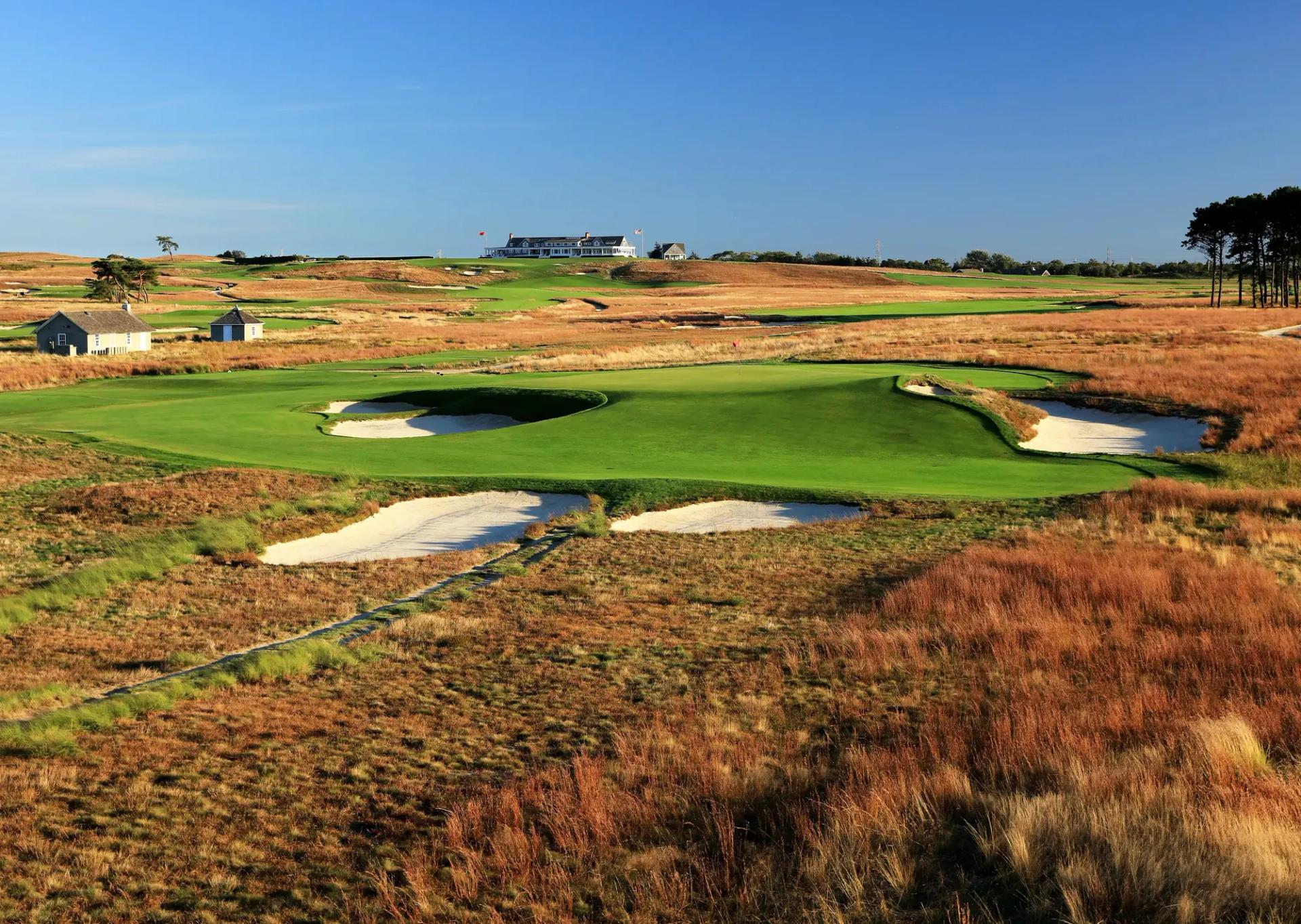
On 260 acres Flynn kept the holes changing direction, and Golf Club Atlas counts just two spots where back-to-back holes point the same way. The 3rd, 12th and 14th, usually downwind, are long and open in front so the ball can run; the holes that turn into the wind are shorter, with smaller targets. More than 150 bunkers wait where closely mown slopes feed balls into them. The back nine runs along the high ridge for Nos. 10 through 13 before the 14th drops away and the round climbs back to the clubhouse. The Red tees measure 6,940 yards at par 70 (74.7/145).
The 7th is the Macdonald and Raynor Redan, its green pitched hard from right to left. Golf Club Atlas wonders whether it is the hardest Redan in the world, while noting that National's 4th, the more famous Redan, overshadows it.
Championships across three centuries
The club hosted the second U.S. Open and the U.S. Amateur in 1896, on a layout that predates Flynn's course by 35 years, and the U.S. Women's Amateur in 1900. The Walker Cup came in 1977. The U.S. Open returned in 1986 (Raymond Floyd), in 1995 for the championship's 100th anniversary (Corey Pavin), in 2004 (Retief Goosen) and in 2018 (Brooks Koepka). The USGA describes Shinnecock as the only club to have held the U.S. Open in three different centuries.
The sixth Open there, in June 2026, went to Wyndham Clark, who led from start to finish and held off Sam Burns by one shot for his second U.S. Open title. The club lists its next championships as the 2036 U.S. Women's Open and U.S. Open, to be played back to back.
National Golf Links of America: Macdonald's ideal holes
Charles Blair Macdonald, who had studied the best holes in Scotland and England, founded National in 1908 to build an American course out of their ideas. To survey and build it he hired Seth Raynor, a Southampton engineer who, The Fried Egg notes, had never heard of golf; the course was finished in 1911, and the partnership went on to shape American design. Its 253 acres sit on Peconic Bay, and the card reads par 72, 6,935 yards.
The template holes
The club names five of its borrowed originals: Prestwick's Alps, North Berwick's Redan, Sandwich's Sahara, and the Road Hole and Eden from St Andrews. Planet Golf places the closest copies early. The 2nd, the Sahara, opens with a blind drive over a hill. The 3rd, the Alps, asks for an approach over a steep rise to a hidden, heavily contoured green. The 4th is the Redan: a long, angled green on a crest that falls away at the back. Later come the Road-hole green at the 7th, a cape hole at the 14th and the punchbowl green at the 16th beneath the club's windmill. The round ends with a par 5 along the bayside bluffs.
Copying was never the whole point. Macdonald wanted choices in place of the forced carries of the day, so the fairways are wide, the bunkers punishing but avoidable by another route, and the huge greens often crowned and steeply contoured. The Fried Egg treats it as the course that started the Golden Age of American design, and Raynor carried its templates across the country. Restoration work in the 2000s was Gil Hanse's.
Of the two, Shinnecock is the sterner examination of ball-striking in wind; National is the more playful course, full of blind shots and slopes that reward local knowledge, hence GOLF's advice to heed the caddie.
The Walker Cup's birthplace
The Walker Cup began here in 1922. According to the USGA, it was the home club of George Herbert Walker, the USGA president who donated the trophy. The match returned in 2013, when the United States won 19-7, and the USGA has named National for the 2030 Curtis Cup, the women's amateur match between the United States and Great Britain & Ireland, and the 2040 Walker Cup. National has never held a men's major; its public moments are amateur team matches.
Seeing them as a spectator
Neither club has a public tee time, so the realistic way in is through the gallery ropes. The Fried Egg makes the same case: if you will never play Shinnecock, a championship there is worth the trip. For the 2026 Open, the USGA opened presales to its own members in November 2025, ahead of a public sale later that month, and gallery tickets let fans walk the course and use the grandstands. For Shinnecock's 2036 championships and National's 2030 and 2040 matches, the USGA is the place to watch for tickets and spectator details.
The neighbors: Sebonack and Southampton
Two more private clubs fill out what The Fried Egg calls perhaps the best pocket of golf in America. Sebonack Golf Club, beside National and Shinnecock on Great Peconic Bay, is a 2006 collaboration between Jack Nicklaus and Tom Doak; Macdonald had looked at that land in 1906 before choosing National's ground. It held the 2013 U.S. Women's Open, won by Inbee Park, and is No. 9 in Golf Digest's 2025-26 New York ranking. Southampton Golf Club is a Seth Raynor design, dating its first season to 1926, the year he died, and brought back toward his style by Brian Silva, with a Redan, a Biarritz and a Punchbowl among its templates. Both are for members and their guests.
Where visitors can play
For a round on the East End, Montauk Downs State Park Golf Course is the answer. New York State Parks runs it, Robert Trent Jones Sr. redesigned it in 1968 with his son Rees assisting, and wind off the ocean and the bay makes it a different course from one day to the next. It is named on Golf Digest's Best Public Courses in New York (September 2025). Residents of New York State get their own rates.
For a U.S. Open course the public can play, the answer is Bethpage Black, the walking-only state park course where Tiger Woods won the 2002 U.S. Open and Lucas Glover won in 2009; the Bethpage Black tee-time guide explains how to get on. The region's other public and semi-private courses are in the Hamptons and Suffolk County guide and on the Suffolk & the Hamptons course list; the New York rankings guide shows the full list.
How to book
Shinnecock Hills, National Golf Links, Sebonack and Southampton Golf Club are private clubs for members and their guests, with no public tee times. Montauk Downs books through the New York State Parks online reservation system, where golfers register before booking. Bethpage Black has its own system, covered in the tee-time guide. We don't sell tee times; each public course page links to its own booking route.
Common Questions
Frequently Asked Questions
- Can the public play Shinnecock Hills?
- No. Shinnecock Hills is a private club for members and their guests, and it has no public tee times. Most golfers see it as spectators at a USGA championship; the club lists the 2036 U.S. Women's Open and U.S. Open, played back to back, as its next. For a public round on the East End, Montauk Downs State Park is the wind-exposed alternative, and Bethpage Black is the Long Island U.S. Open course the public can book.
- How can the public watch a championship at Shinnecock or National Golf Links?
- Buy a ticket when the USGA sells them. For the June 2026 U.S. Open at Shinnecock, the USGA opened presales to its members in November 2025 before a public sale later that month, and gallery tickets let fans walk the course. Shinnecock's next championships are the 2036 U.S. Women's Open and U.S. Open. National is scheduled for the 2030 Curtis Cup and the 2040 Walker Cup, according to the USGA, which publishes spectator details for its events.
- What makes National Golf Links' template holes distinctive?
- C.B. Macdonald modeled them on famous British holes and fitted them to Southampton ground. The 4th is a Redan after North Berwick, a long, angled green on a crest that falls away; the 3rd is an Alps after Prestwick, with an approach over a hill to a hidden green; the 2nd is a Sahara after Sandwich. Generous fairways leave alternate routes around the bunkers, and Seth Raynor, who helped build the course, spread the templates nationwide.